Buying Certificates,
a step by step guide
Buying Kolekt Certificates
Watch the video
All the steps in one video
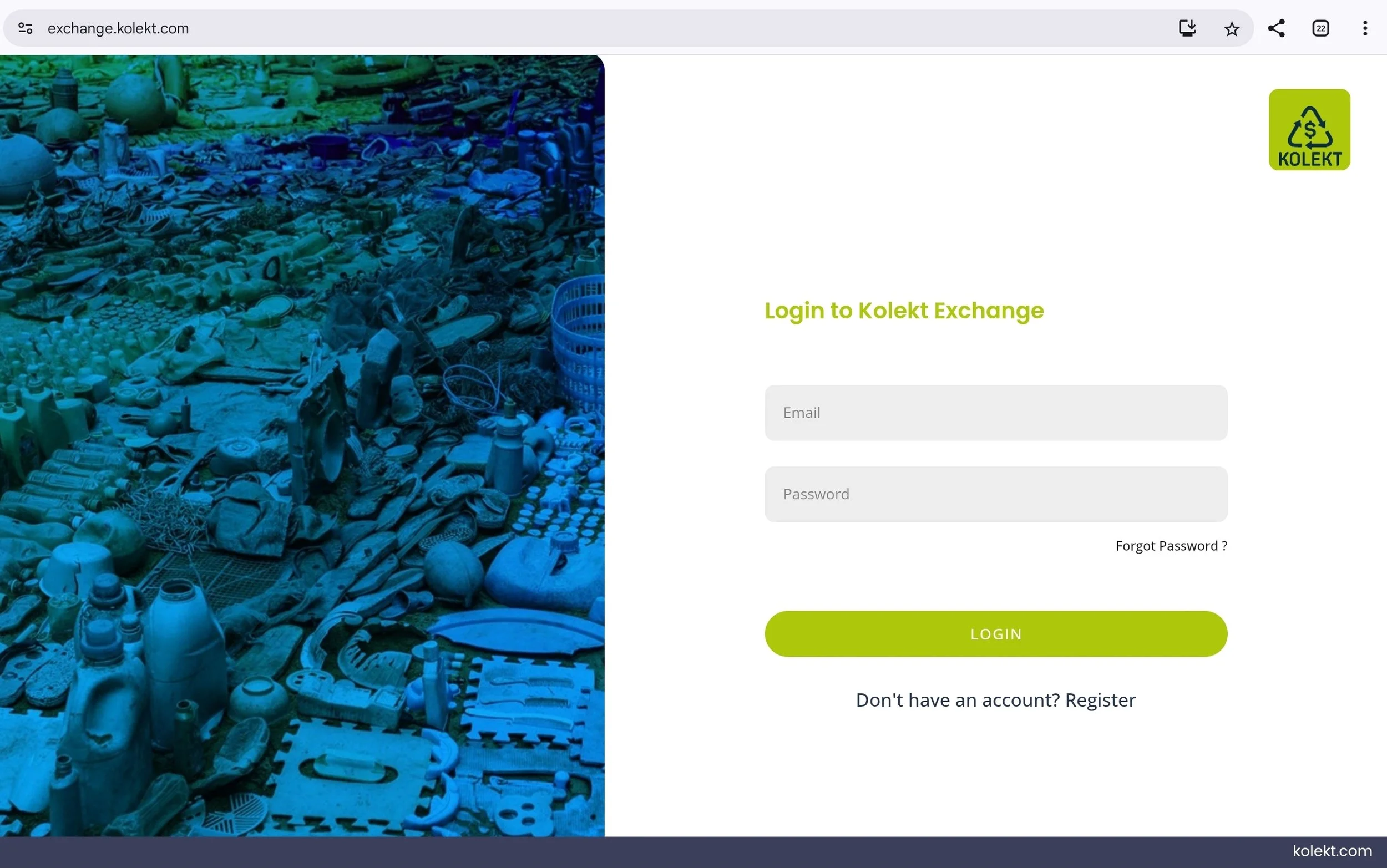
Register or Login as a Brand, PRO, buyer —> https://exchange.kolekt.com
You can login or register with us as a certificate BUYER.
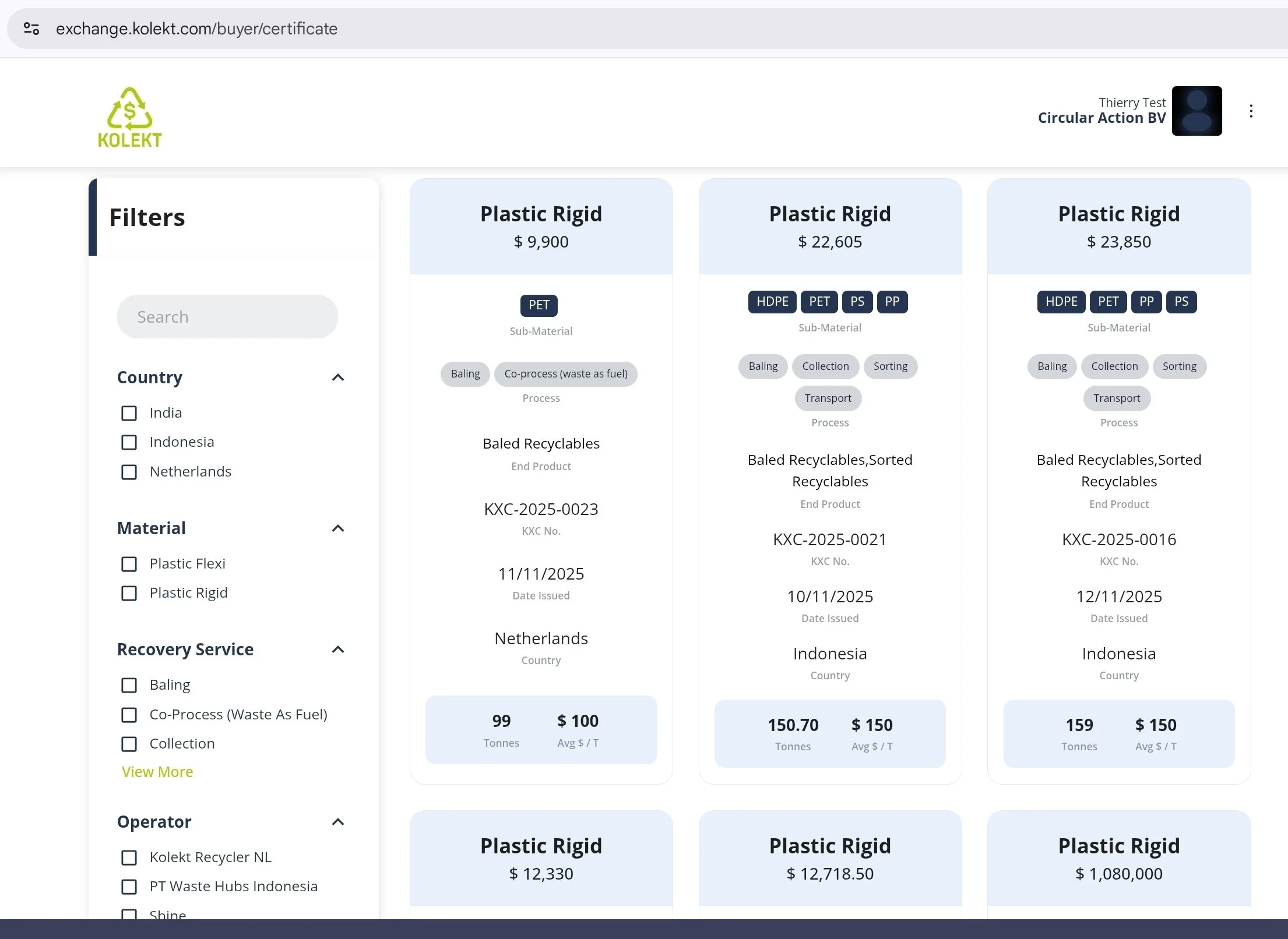
The Kolekt Exchange Dashboard
Here you can
View the available certificates
Filter certificates by country, material, operator
Buy / place an order for a whole or part of a certificate
view your Order History and process
Modify your profile - this is only needed if you place an order
Visit the dashboard here —> https://exchange.kolekt.com/buyer/certificate
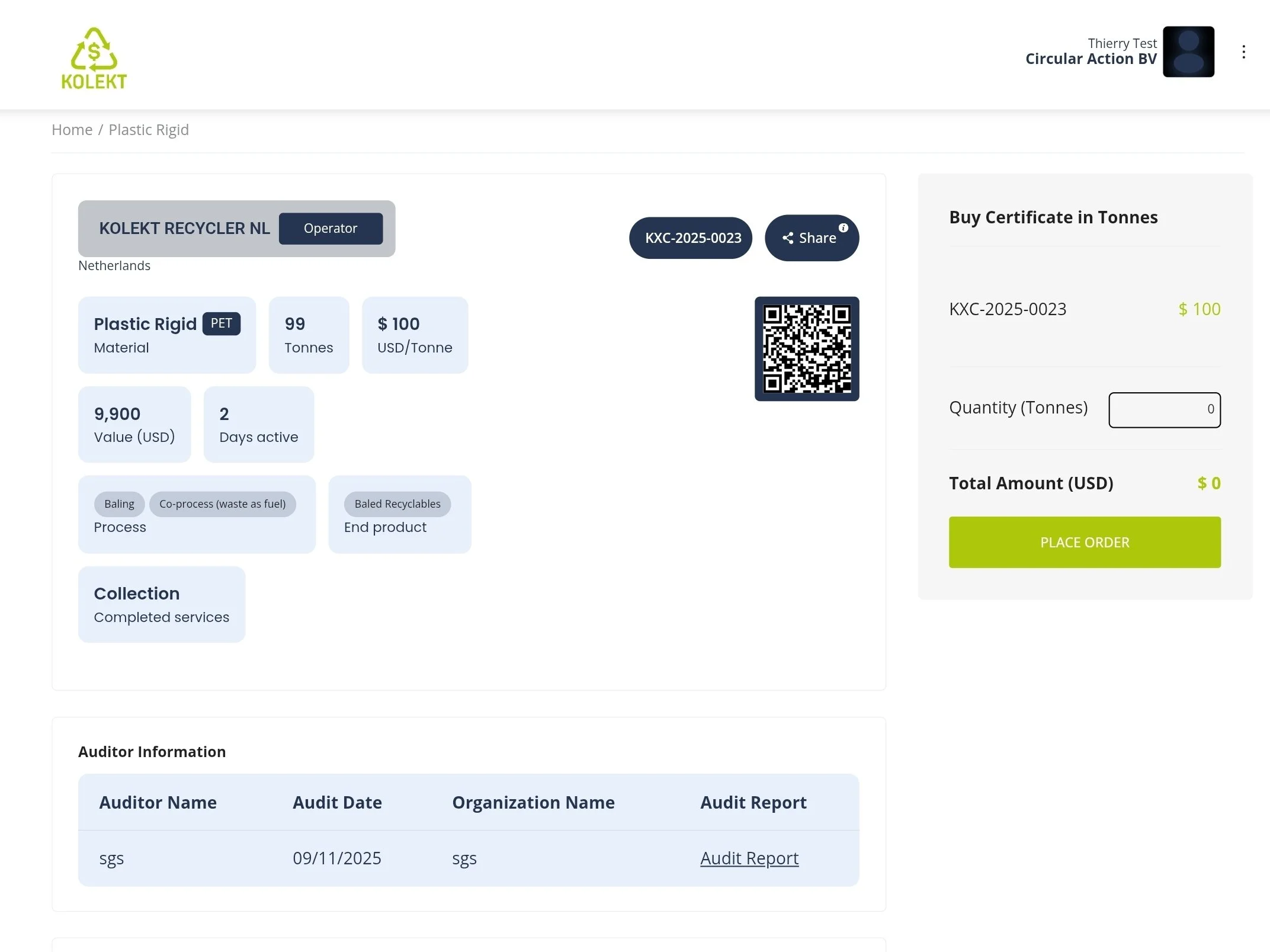
View share and buy (part of) a Certificate
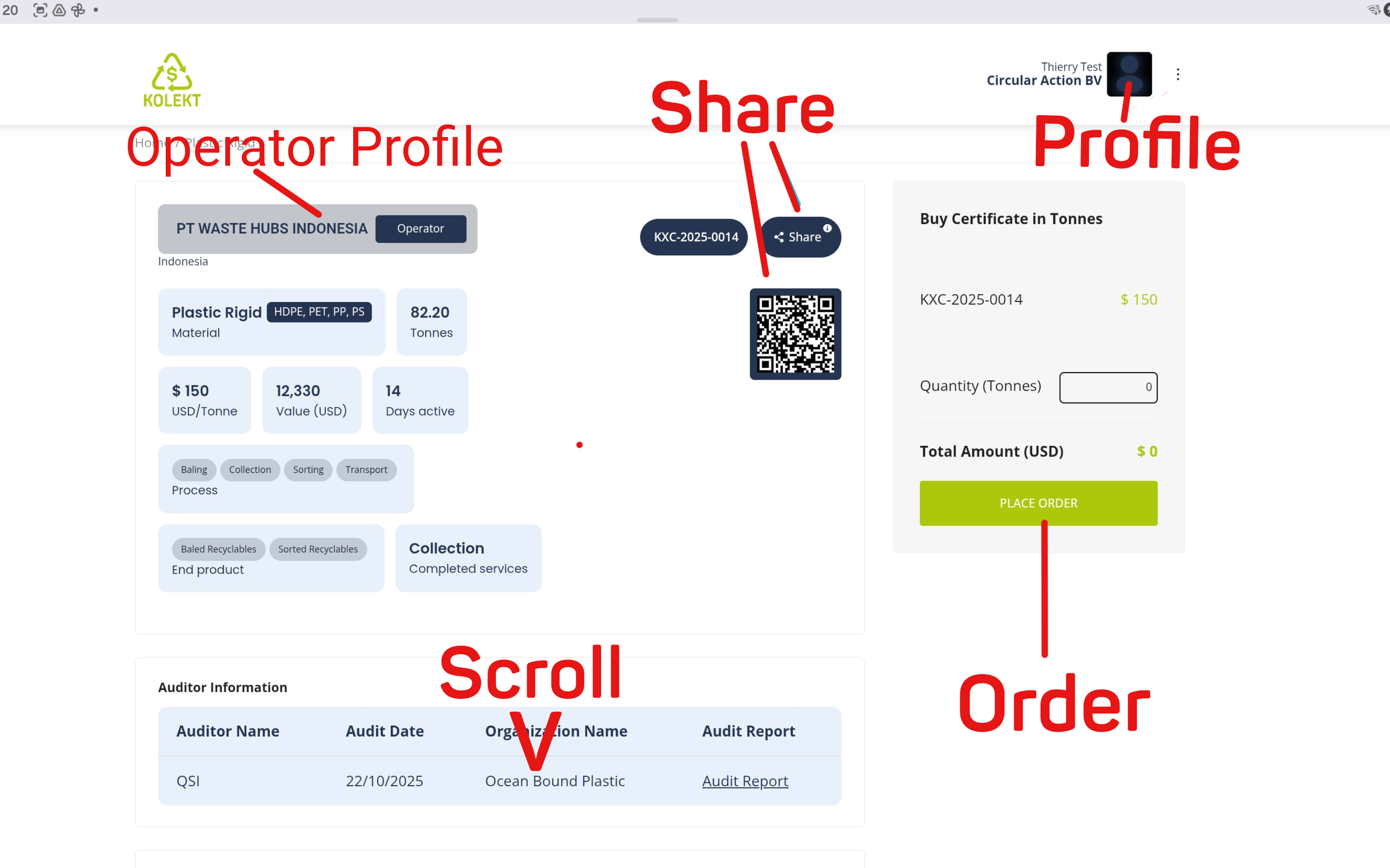
The Certificate provides information about the operator, materials, inputs, outputs and audit statement. From here you can:
View the operator profile and company documents;
You can share the certificate by using the share link via email, whatsapp or the QR code via printed media;
View the documents of proof of sales, deliveries and purchases. These are confidential and you will access approval from the operator;
Place an order and buy part of a certificate
View your order history and modify your profile (if you order)
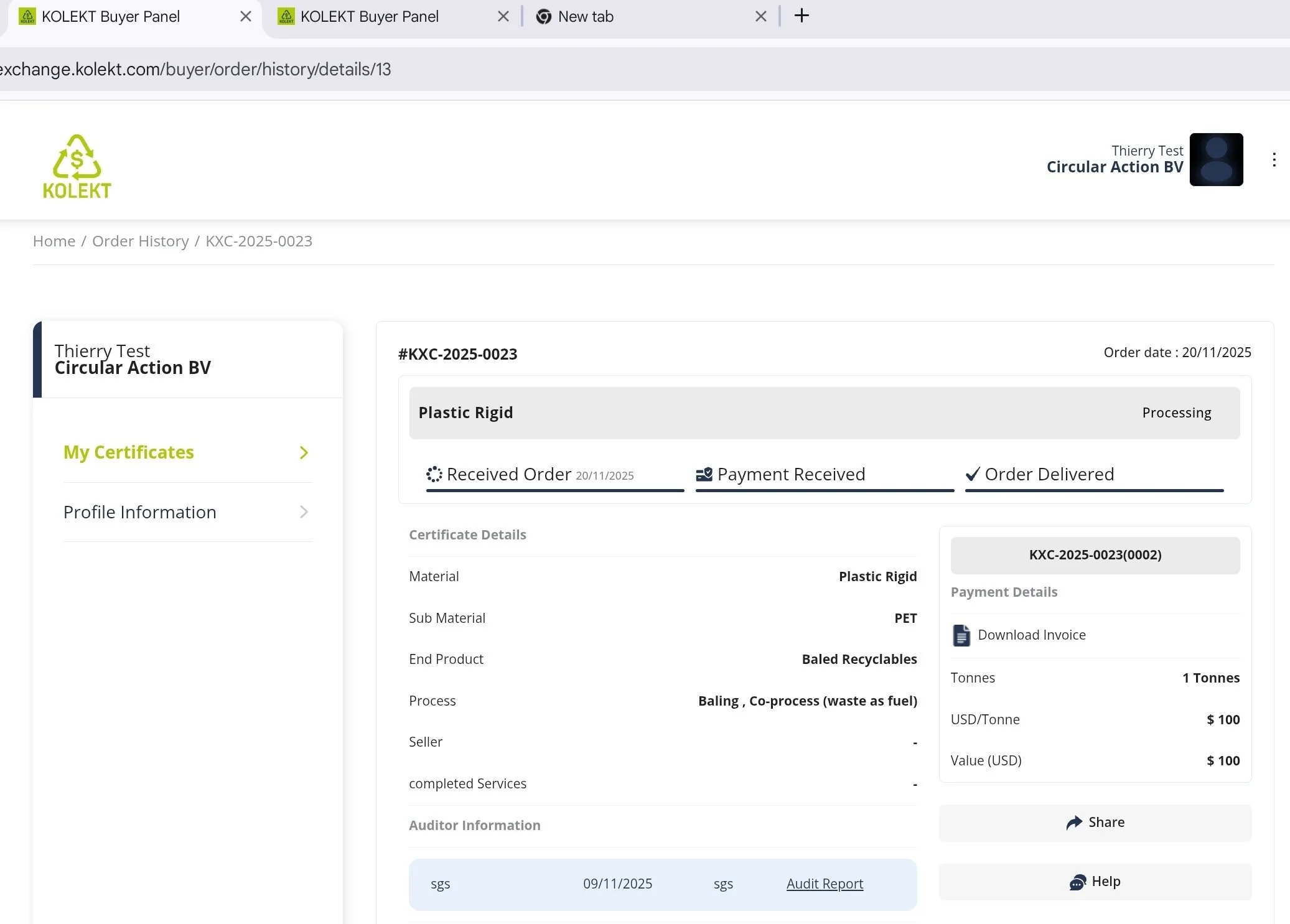
The Order & Payment Flow
Order a number of tonnes
Preview your order and Certificate, then confirm
Update your address information is completed in your profile
An invoice is sent you by Kolekt
You have 14 days to pay the invoice, if not the tonnes ordered are cancelled
You receive your unique digital Certificate in PDF form
Kolekt will then transfer 95% of the payment to the operator
The Price of a Certificate
The price of a certificate in USD/tonne, should be
= the true cost of waste collection and delivery to a buyer or end destination
less (-/-)
the price paid for the material by the buyer of the material (buyback center, recycler or end-destination).
The asking price (USD / tonne) of a certificate depends on several internal and external factors.
(1) The base price of a certificate should be the price per tonne needed to cover the gap (if any) in the total cost of waste recovery. If the market price for the waste materials are lower than the true cost of waste recovery, this gap or deficit can be complemented by the price of the certificate.
Lets take PET as ann example. The true cost of collection and delivery of PET to a recycler is USD 200 per tonne, but the recycler only pays USD 150 per tonne for the PET at its gate. By pricing the certificate at USD 60 per tonne the costs (of the collectors) are covered and there is a $10 margin (5%) per tonne. At this price it becomes financially attractive to collect and process the waste material - assuming the recycler will increase its buying price to $200. However, if the price paid at destination (e.g. a recycler) is higher than the cost of collection, then the certificate price should be 0 or at least high enough to cover the cost of the annual audit and the Kolekt fee.
Examples of such waste recovery cost deficits (that can be covered by the certificate price) are:
waste pickers are paid less per KG than what would constitute a living wage. As a rule of thumb a living wage is 120% of minimum wage,
No value: no one is paying a price per KG for the waste material (examples are glass, MLP, beverage cartons, rubber, textiles, diapers/nappies, construction waste). These materials badly need to be collected and processed, so the certificate price needs to full cover the cost of collection and processing, disposal or recycling.
Transport costs: the distance between the point of collection and recycling make the transportation costs too expensive,
No processors: waste processing and recycling is not available or isn’t commercially attractive (as is often for materials like PVC, EPS, MLP, glass, textiles),
tipping fees at landfill or factories for co-processing or waste to energy add to the waste recovery costs.
(2) The EPR Fee for a material will influence the asking price of certificates. Generally the Certificate price per tonne should be lower than the EPR Fee. Thereby making the purchase of a certificate a cost effective method for a brand to prove its contribution to waste collection and/or recycling.
However, if the EPR Fee per KG is lower than the true cost of waste recovery then there is something seriously wrong with the EPR Fee pricing mechanism. The Fee should be revised upwards to a point where the EPR Fee encourages, or does not discourage, the collection and processing of waste. If the EPR Fee is lower than the recovery cost, it will push down the price of certificates.
If the EPR Fee is higher than the true cost of recovery, then Brands will be encouraged to buy certificates as a cheaper alternative proof of compliance with EPR targets and regulations.
(3) Plastic credits are usually sold in countries with no EPR regulations or where EPR regulations encourage the use of plastic credits. In these countries the certificate price (for plastics only) will probably be slightly lower that the price of a plastic credit (in USD per tonne), because plastic credits should be issued for tonnes that are “additional” to the tonnes collected or recycled in the past. The tonnes collected or processed prior to the plastic credit issuance are called “the baseline”. Since the additional tonnes are usually smaller or equal to the tonnes collected prior to the plastic credit project, the cost of recovering the additional tonnes.
(4) Sharing the revenues of Certificates downstream. If your company issues Certificates and you share the revenues of the certificates downstream, by offering a higher price per KG to your suppliers, then your Certificate price ought to be higher, than if you keep the certificate proceeds for yourself without offering a higher price to your suppliers.
As a guideline, Kolekt recommends that the Certificate proceeds are shared in 3 equal parts of 33% each across the supply chain. Each actor will want a higher portion claiming higher Capex investments (recycling) or higher labour effort (collection), so a simple flat 33% spread avoids endless discussions.
A fair share of certificate proceeds across the supply chain
33% for the recycler/end-destination;
33% for the intermediaries, which includes sorting, baling and transportation; and
33% for the first mile of segregated collection at source (including informal waste collectors).
If only the recycler issues certificates priced at $300/tonne on behalf of the whole chain, the recycler can keep $100/t for itself, and pay out $200 downstream by
(i) adding $0.20 / kg to the purchase price of feedstock, and the intermediary must increase the buying price by $0.10 / kg, thus sharing the proceeds downstream. Or
(ii) keeping the buying price the same, but using the Kolekt App to transfer the payments downstream. Contact us to organise this.
If each supply chain actor issues certificates for themselves, then the Certificate price should be 33% of the total recovery price gap per tonne for the whole supply chain. Contact us to get the price right before issueing certificates.
(5) The Kolekt Fee is maximum 20% of certificate price. When the Buyer’s payment is made, Kolekt will deduct the fee and transfer the remainder to the issuer of the certificate.
What does a certificate look like?
Has been purchased by a consumer goods company, for 1 tonne. For the service of Collection by the operator Kolekt Recycler NL.
By clicking the link or the QR code at the bottom left, the viewer can inspect the underlying documents of proof.
KOLEKT has verified all underlying documents, the operator and the audit report.
A PDF file of a Purchased Certificate
Which can be valided via the QR code or link

The same Certificate, online
containing all documents of proof